The Truck Has to Fit into the Parking Space
One Minute Charge #04

Charging infrastructure only works if the vehicle can actually use it.
A lot of public fast chargers were designed with passenger cars in mind. This makes sense, since most EVs on the road today are passenger vehicles.
The problem is that commercial trucks are not passenger cars. They’re longer. They’re taller. They need more room to maneuver. And when they pull into a charging station designed for compact vehicles, something awkward often happens: the truck doesn’t fit.
Sometimes the stall isn’t deep enough. Sometimes there isn’t enough space to turn. Sometimes the truck blocks multiple spaces just trying to reach the charger.
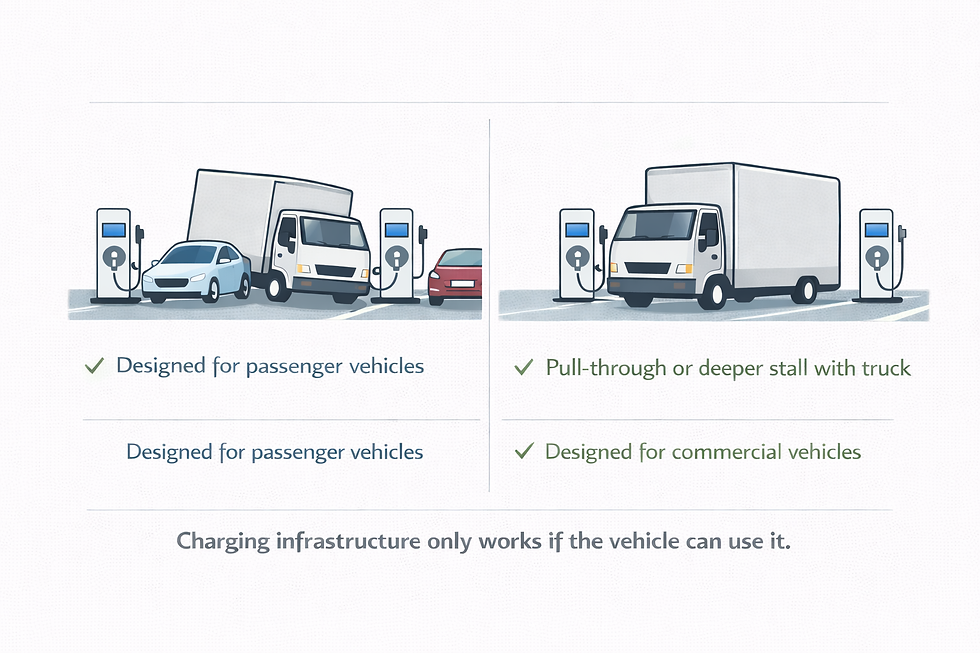
The charger itself may work perfectly. But if the vehicle can’t park there, the charger might as well not exist. For passenger EV drivers, this is mostly an inconvenience. They can drive around and look for another station.
For commercial fleets, it’s a much bigger issue. Work vehicles operate on schedules and often set routes. Drivers can’t spend time hunting for a charger that physically fits the vehicle.
That’s why infrastructure designed for passenger cars doesn’t always translate well to commercial fleets. Because when it comes to charging trucks, the first requirement isn’t power or speed.
It’s something much simpler: The truck has to fit into the parking space.